
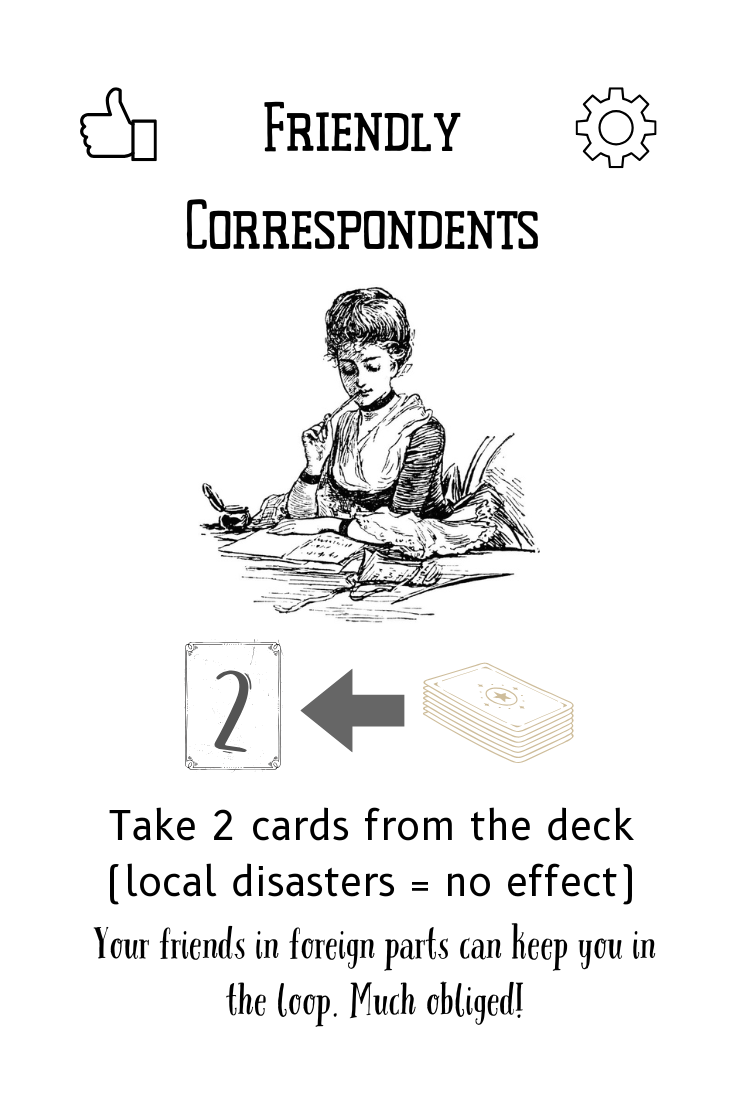

It’s Fortuna Friday, friends! Exciting developments are happening behind the scenes to propel the game towards crowdfunding, and I hope to share more details soon. For now, we’re featuring a very cute little action card from the game – “Friendly Correspondence”.
Nothing was more important than good letter writing for a merchant in the age of sail. Letters weren’t just a source of information and a way of sending instructions. They were vital in establishing trust between people who had often never met one another. If you wanted to be introduced to new business associates, a letter of recommendation was essential. If you wanted to check on the reputation of a new contact, you asked your correspondents for their opinions.
Even using the right words and turns of phrase were important. By employing certain stock idioms and modes of address, you showed a correspondent that you were part of the same in-group. Your prose implied you were as well-versed in business practice as you were in letter writing. Poor correspondence would be like having a business website from the 1990s with blue hyperlinks and WordArt everywhere – hardly reassuring.
For this reason, letters gradually became ever more standardized across the 1600s and 1700s. A truly global correspondence culture emerged, used by merchants of many nationalities and religions, from Goa to Philadelphia. Manuals started to be published teaching people how to get the most out of their missives. In some cases, they even provided model letters you could simply adapt and send – a kind of ChatGPT for the eighteenth century.
One of these manuals was penned by none other than Daniel Defoe. More famous for novels like Robinson Crusoe, Defoe also found time to write The Compleat English Tradesmen – one of the first business self-help books. Daniel helpfully opens by giving an example of how not to write a business letter:
‘SIR,
The destinies having so appointed it, and my dark stars concurring, that I, who by nature was framed for better things, should be put out to a trade, and the gods having been so propitious to me in the time of my servitude, that at length the days are expired, and I am launched forth into the great ocean of business…
STOP. Your letters must be succinct and to the point. A few gallant flourishes are sine qua non, but don’t go overboard. In fact, according to at least one letter-writing manual, long poetic letters imply that you don’t have enough business going on to keep you occupied! A short, pithy letter is thus a kind of flex, like sending an email to your subordinates in the small hours of the morning.
Succinct doesn’t mean your letters should be unsentimental, however. The most common word in business letters from the 1700s is “friend”. Why? Because a friendship implies reciprocity. There was not necessarily any real affection between such ‘friends’. Instead, it semantically piggy-backs on the concept of friendship to imply dependability and a commitment to look after one another’s interests. In world where news travels relatively slowly, having a correspondent on the ground watching your back was essential.
While we’re on the subject of dependability, do try to reply promptly to your letters. When new contacts ask around about you, you want people to talk of your ‘good correspondency’. This phrase means dependability in both business and letter writing. Just like people who disappear from WhatsApp for days at a time, people who reply to letters sporadically rarely inspire confidence.
However, if you are a flaky replier, never fear. Most surviving letters open with an apology for not having replied sooner – a reassuring reminder that some things don’t change.
In the game, the card ‘Friendly Correspondents’ allows you to pick up two cards from the main deck, ignoring the effects of any disasters. Much obliged!
Now, friend, please demonstrate your good correspondency by replying to this email, by commenting online, or – best of all – by forwarding it as a letter of recommendation to a friend who would just love playing FORTUNA, the historical card game.
With my friendship and deep affection,
Jake.
Comments
One response to “#4. I hope this letter finds you well”
A heart-felt piece of writing my friend!